Table of Contents
Operating a business as a truck driver involves dealing with scheduling, documents, truck maintenance, and other health factors. DOT physical is yet another thing that you need to deal with, and it becomes extremely important when your business is riding on your eligibility to drive.
If you are searching about DOT physical for owner-operators Florida, then surely you would be interested to know about all those things that one should take care of prior to the examination. This guide tells you everything that you should know before booking.
What Should Owner-Operators Know Before a DOT Physical in Florida?
A DOT physical tests you for compliance with the standards of being medically fit to drive a commercial motor vehicle. The federal regulations pertain primarily to those who operate trucks across state lines weighing 10,001 pounds and over. There may be some exceptions regarding some passenger vehicles and vehicles transporting hazardous materials as per placards.
The requirements vary based on the kind of truck you drive and the tasks you perform using it. As a CDL driver, find out the medical self-certification category applicable to you. Being aware of the DOT medical card requirements for Florida truck drivers will ensure that your annual physical does not end up costing you a day’s pay.
What Documents Should You Bring to Your DOT Physical?
Missing paperwork will delay everything, particularly if the examiner requires additional data regarding a medical issue. Obtain all of the required DOT physical documentation prior to your scheduled examination:
- Photo identification: Driver’s license or any acceptable alternative.
- Medical certificate: It is necessary for you only if you have one.
- List of medications: List of medications and their dosage along with the doctors prescribing them.
- Medical documentation: All the documentation pertaining to your health problems like diabetes, heart trouble or hypertension.
- Documentation for particular conditions: It may be the case that a compliance report or documentation might be required for you if you have CPAP or specialist visits.
- Correction lenses: It includes glasses, hearing aids and contact lenses.
Ring the clinic in advance to know what documents you should take. It will help you in having an easy visit to the clinic.
How Can You Prepare for the DOT Physical Examination?
A little preparation goes a long way. Sleep well at night, be punctual, and do as instructed by the clinic.
Take your medication as directed. You will only complicate things by not taking your dosage to manipulate the results. Reflect upon your medical background, including past surgical operations, your present conditions, and any changes you have had recently in your body condition. Be honest when answering the examiner’s questions even when you would not want to.
Taking these steps can help you avoid common CDL Medical Exams mistakes, such as forgetting medical documents, leaving out important health details, or arriving without your corrective glasses.
What Happens During a DOT Physical?
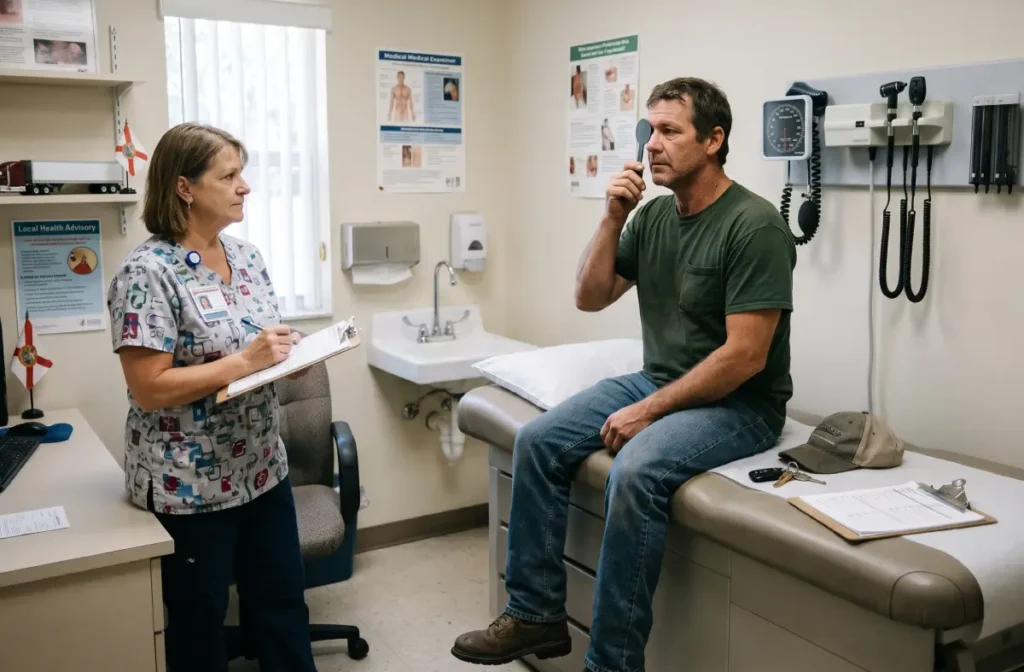
The exam starts with a review of your medical history, followed by a physical exam to determine whether you meet the required health standards for commercial driving.
Here’s what usually happens:
– Screening of vision and hearing to confirm that you meet the required health standards.
– Testing of your blood pressure and pulse to determine your heart and blood conditions.
– Testing urinalysis to look for certain signs like glucose, blood, and proteins.
– Physical exam of your body to find out more about particular systems and issues.
– Examining of you by the medical examiner that is certified by the FMCSA National Registry.
The medical certificate is valid for 24 months. However, the medical examiner may decide to certify for a shorter time when necessary.
When comparing a DOT physical vs CDL medical exam, the terms generally refer to the same medical examination used to determine whether a driver meets the health standards for commercial driving. Neither term automatically includes a drug test.
What Medical Conditions Could Affect Your DOT Medical Certification?
Having a medical condition doesn’t automatically disqualify you. The examiner looks at how serious it is, how well it’s treated, how stable it is, and whether it could affect your driving.
Some conditions may call for extra review:
- High blood pressure: You may need monitoring or a shorter certification period.
- Diabetes: The examiner can inquire about treatment or test results.
- Sleep apnea: You may have to present information from your sleep study or CPAP use.
- Heart diseases: You may have to produce additional documents or get a specialist’s evaluation.
- Blindness and hearing problems: You must pass the required standards or meet some exemptions and alternatives.
- Prescription drugs: The examiner might want to know if any drug has an effect on your safe driving skills.
Make sure you have your documents and ask the examiner if anything else is needed. A diagnosis alone doesn’t decide the outcome.
Do Owner-Operators Need a DOT Drug Test Along With Their Physical?
The DOT physical checks your medical fitness. DOT drug testing is about following federal drug and alcohol rules. They’re two separate requirements.
If you drive a CDL-required commercial motor vehicle on public roads, you’re generally subject to federal DOT drug and alcohol testing rules. Independent owner-operators also need to meet the consortium and random-testing requirements that apply to them. The FMCSA’s owner-operator guidance has the details.
To get the complete picture about drug testing of truck drivers in Florida, one should first understand what kind of regulations are applicable to their particular business operations.
What Type of DOT Drug Test Is Required in Florida?
The Type of DOT Drug Test required is determined by the purpose of the test and varies according to federal classifications into pre-employment, random, reasonable suspicion, post-accident, return-to-duty and follow-up testing.
A urine sample collected as part of the medical examination during your DOT physical exam is not necessarily a drug test. DOT drug testing follows its own procedures.
When Is Post-Accident DOT Drug Testing Required?
Post-accident DOT drug testing in Florida isn’t required after every crash. Federal rules generally require testing after qualifying fatal accidents and certain other crashes involving injuries or disabling vehicle damage, when the citation criteria are met.
When testing is required, federal deadlines apply. Testing usually needs to be conducted within eight hours for alcohol testing and 32 hours for controlled substance testing.
You should contact your motor carrier and testing program administrator and take the necessary actions. The FMCSA’s testing guidance explains the rules in detail.
What Happens If You Do Not Pass Your DOT Physical?
This will depend on what the examining physician discovers during the examination, which may result in issuance of the medical certificate, a temporary medical certificate, or requirement for additional documentation.
Find out what documents you need and what should be done. You may need updated test results, an opinion from specialists, or evidence that your condition is under control.
A medical concern doesn’t always mean you’re permanently disqualified. You do, however, need to meet the applicable standards before driving any vehicle that requires medical certification.
Getting Ready for Your DOT Physical?
Don’t let incomplete paperwork or unanswered questions put off your physical examination. Make an appointment with Transportation Medicine through Dr. Weinberg to ensure that you know what you need before coming in.
How Can You Avoid Delays in Getting Your DOT Medical Card?
Being prepared avoids being in a tight situation at the last moment.
- Get your test done before the expiration of your existing certification.
- Select an examiner from the FMCSA National Registry.
- Prepare all your medical records and your list of medications.
- Check whether there is any extra documentation that needs to be fulfilled for your condition.
- Ensure that you have up-to-date certification of medical examiners.
Is it possible for you to operate your business if you are waiting for your CDL medical certificate? It depends on whether or not you have your certification already. Also, it depends on the conditions of your business. It is important for you to realize that the notice of appointment and other documents do not qualify you to drive. Confirm your status with the appropriate licensing authority before you operate a commercial vehicle.
Important 2026 Medical Certification Update
As of October 12, 2026, the temporary federal allowance that let CDL holders use a paper medical examiner’s certificate as proof of certification has ended in Florida and other states. Alaska is the exception.
Medical examiners will certify their findings electronically to the state licensing agency. Do not discard any documentation that the examiner provides to you; however, you should verify your actual status instead of relying solely on the certificate. The most up-to-date information can be found at the FMCSA National Registry II Learning Center.
Where Can Owner Operators Obtain a DOT Physical Exam in Florida?
It is important that you choose an appropriate clinic based on the list available at the FMCSA National Registry. Check ahead of time to see if appointments are available and what they will cost.
If you’re looking for a DOT physical Clearwater FL appointment, use the National Registry to find a qualified examiner in your area. Call the clinic to confirm their services and ask whether they need any extra medical records.
You don’t need a trucking company to sponsor you before you book a DOT physical. Independent owner-operators can arrange their own exams.
Conclusion
Maintaining your medical certification up-to-date is one way of ensuring that your trucking enterprise operates efficiently. Preparation of documents, knowledge of the examination process, and confirmation of your official status can ensure that no unnecessary delays happen.
Transportation Medicine, led by Dr. Weinberg, helps drivers handle their commercial medical exam needs. If you’re planning your next DOT physical, reach out to ask about appointment availability and what to bring.
Ready to schedule? Contact Transportation Medicine through Dr. Weinberg to discuss your appointment and take the next step toward your medical certification. Call (727) 648-2402 or email aweinberg@medavex.org to get started.