Table of Contents
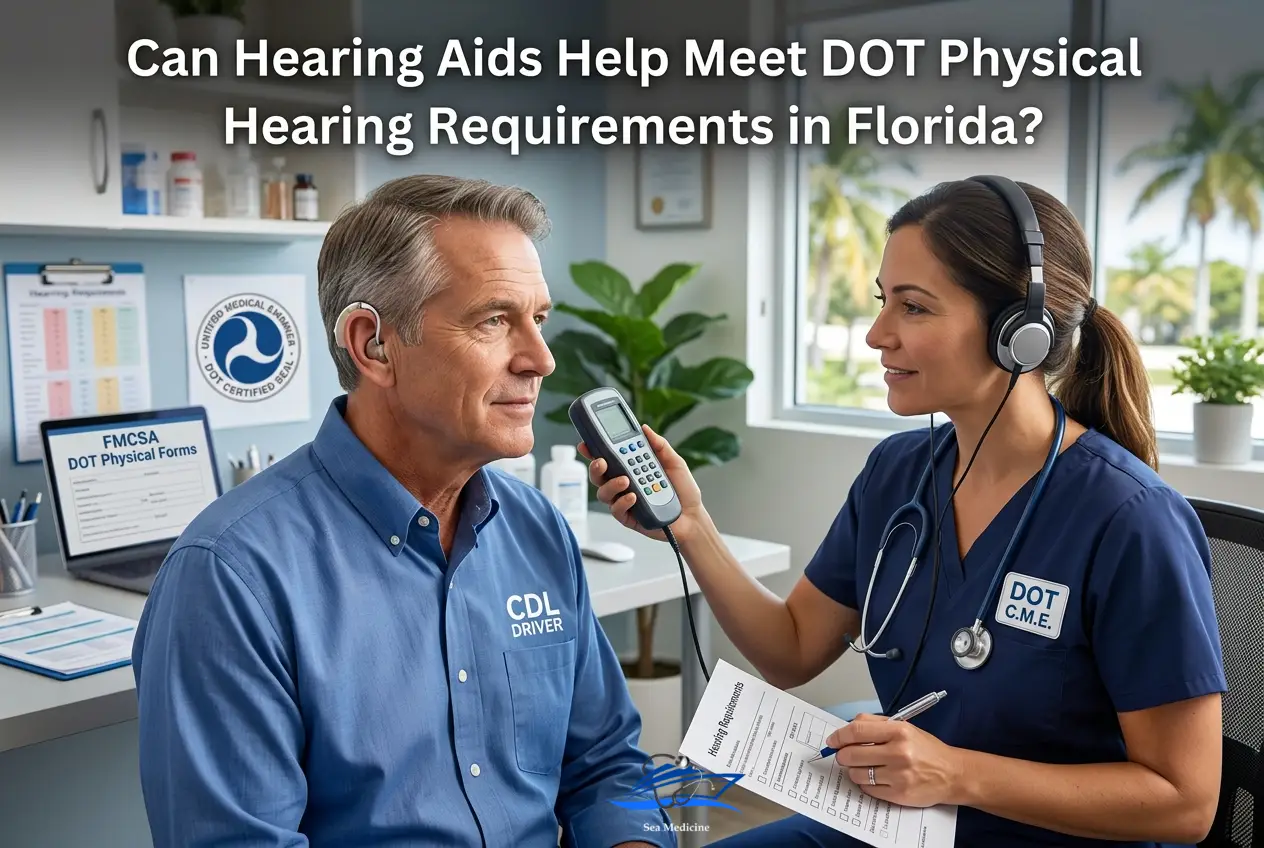
Yes. Hearing aids can help a commercial driver meet the federal hearing standard during a DOT physical. Using a hearing aid does not automatically disqualify you from getting medically certified.
For drivers with hearing loss, the important question is whether they can meet the applicable hearing standard during the required evaluation. Federal rules allow the standard to be met with or without a hearing aid, giving some drivers an opportunity to qualify with the hearing assistance they normally use.
Understanding the DOT physical hearing requirements Florida CDL drivers may encounter can also make the appointment less stressful. The hearing evaluation may involve a forced whisper test or an audiometric test, depending on the circumstances.
What Are the DOT Hearing Requirements for CDL Drivers?
Federal regulations provide two ways to demonstrate adequate hearing for commercial driving. A driver may qualify by hearing a forced whispered voice from at least 5 feet in the better ear, with or without a hearing aid. An audiometric evaluation is another option, with an average hearing loss of no more than 40 dB at 500, 1,000, and 2,000 Hz.
These standards are part of the federal medical qualification requirements for commercial motor vehicle drivers. For drivers preparing for a Medical Certificate for CDL, understanding these hearing requirements can make the certification process easier to navigate.
The Two Hearing Tests Used for CDL Medical Certification
Hearing Evaluation | Federal Standard |
Forced Whisper Test | Hear a forced whispered voice from at least 5 feet in the better ear |
Audiometric Test | Average hearing loss of no more than 40 dB at 500, 1,000, and 2,000 Hz in the better ear |
The two methods measure hearing differently, but both are used to determine whether a driver meets the applicable hearing standard.
Can Truck Drivers Wear Hearing Aids During a DOT Physical?
Yes. Can truck drivers wear hearing aids DOT physical examinations? Federal regulations specifically allow a driver to meet the hearing standard with or without a hearing aid.
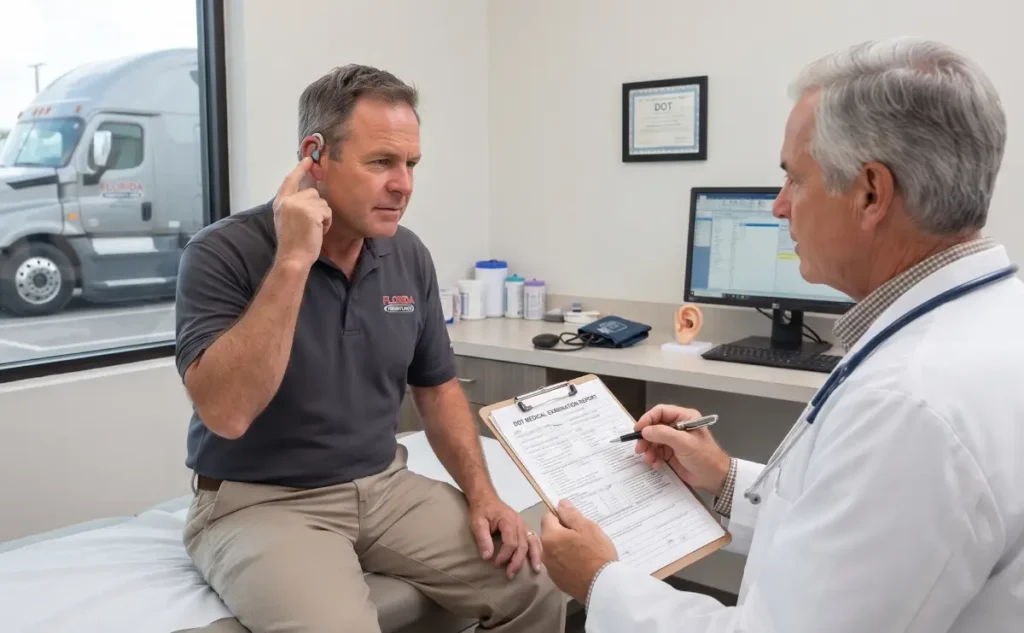
If you normally rely on hearing aids, bring them to the examination. The Medical Examiner will be able to check your hearing while you have the apparatus in which you rely on for hearing in your daily life.
When Can Hearing Aids Help?
Hearing aids help if the driver requires amplification to satisfy the hearing requirement. If you qualify only while wearing them, FMCSA guidance requires their use while driving and documents the hearing-aid requirement on the certification forms.
A Medical Examiner for CDL can explain how this requirement applies to your certification. Using hearing aids does not automatically mean you need a federal hearing exemption.
What Is the DOT Whisper Test?
The forced whisper test is a simple hearing screening performed during the medical examination. The driver sits at least 5 feet from the examiner while each ear is evaluated.
The examiner uses a forced whisper, such as words or numbers, and asks the driver to repeat what was heard. The DOT hearing test whisper test requirements determine whether the driver can hear the required whispered voice at the specified distance.
A Medical Examiner for Truck Drivers in Florida can explain what to expect and how the hearing results may affect your certification.
What Happens When a Driver Does Not Pass the Whisper Test?
Failing the whisper test does not automatically mean you cannot qualify. If the screening does not establish that you meet the hearing standard, FMCSA guidance calls for an audiometric test to provide a more detailed assessment of your hearing. Staying informed about these requirements can also help you understand How Florida Truck Drivers Can Keep Their CDL Medical Certification Active.
If you still do not meet the hearing standard after additional testing, a FMCSA hearing exemption CDL drivers may pursue could be an option for eligible interstate drivers. FMCSA evaluates hearing-exemption applications separately from the standard medical certification process.
Do You Need an Audiometric Test for a DOT Physical?
Not every driver will need an audiometric evaluation.
If the whisper test establishes that you meet the hearing standard, additional testing may not be necessary. If the whisper test is unsuccessful, however, audiometric testing can provide a more detailed assessment.
What Does an Audiometric Test Measure?
An audiometric test measures hearing sensitivity at specific frequencies.
For the federal hearing standard, the relevant frequencies are:
- 500 Hz
- 1,000 Hz
- 2,000 Hz
The average hearing loss in the better ear must be 40 dB or less at those frequencies. The test must also be performed using equipment calibrated according to the applicable federal standard.
An audiometric test DOT physical evaluation can therefore provide objective measurements when a whisper test does not establish qualification.
6 Common Hearing-Aid Mistakes to Avoid During a DOT Physical
The hearing aid device is not generally at fault. Rather, issues arise because the person was not prepared or did not understand how using a hearing aid impacts certification.
1. Arriving Without Your Hearing Aids
If you normally depend on hearing aids, bring them to the examination. You want the examiner to evaluate you under the conditions you normally use for hearing.
2. Forgetting Your Charger or Spare Batteries
Check your devices before leaving home.
- Charge rechargeable hearing aids.
- Bring the charger when appropriate.
- Carry spare batteries if your device uses them.
FMCSA guidance encourages drivers who qualify with hearing aids to have a spare power source available while driving.
3. Using a Device That Is Not Working Properly
A hearing aid that is producing distorted or weak sound can make the evaluation unnecessarily difficult.
Check that your devices are working properly before your appointment.
4. Assuming a Failed Whisper Test Means Automatic Disqualification
A failed whisper test does not necessarily mean you cannot qualify. Additional audiometric testing may be required.
5. Failing to Tell the Medical Examiner About Hearing-Aid Use
Be honest about your hearing history and explain whether you normally use hearing aids.
This gives the examiner a clearer picture of your hearing and the assistance you rely on.
6. Forgetting That Hearing-Aid Use Can Become a Driving Requirement
If you meet the hearing standard only with hearing aids, FMCSA guidance requires you to use them while operating a commercial motor vehicle.
Need Help With Your DOT Hearing Exam?
If you use hearing aids or have concerns about meeting the hearing standard, Dr. Weinberg and his team can help you prepare for your DOT medical examination.
What Should You Bring to a DOT Physical if You Wear Hearing Aids?
A little preparation can make the appointment much easier.
Quick Checklist
- Functioning hearing aids
- Spare batteries or a charger
- Recent hearing records
- Previous medical certification paperwork
- Relevant exemption documents, if applicable
- Information about any recent changes in your hearing
You do not need to bring every medical document you have. Focus on information that could help the Medical Examiner understand your hearing history and previous certification.
If you’re preparing for the entire examination rather than just the hearing portion, Common FAQs About DOT Physical Exam Certification in Florida can help you understand other parts of the process.
Will Your Hearing Aid Be Noted on Your DOT Medical Card?
If you meet the hearing standard with the use of a hearing aid, FMCSA guidance requires the Medical Examiner to select the appropriate “Wearing hearing aid” designation on the medical examination and certification forms. The driver must then use the hearing aid while operating a CMV.
Understanding how a hearing aid noted on DOT medical card documentation affects your driving requirements can help you avoid surprises after certification.
Can Deaf Drivers Get a CDL With a Hearing Exemption?
Yes. Some deaf or hard-of-hearing drivers may qualify through the federal hearing exemption process. However, an exemption is different from qualifying with a hearing aid.
For a DOT physical hard of hearing driver, the first step is determining whether the federal hearing standard can be met. FMCSA hearing exemptions apply to interstate commercial driving; intrastate drivers must follow applicable state requirements.
3 Things to Know About a DOT Hearing Exemption
1. A Hearing Aid Is Not an Exemption
A hearing aid can help a driver meet the existing hearing standard. A federal exemption is a separate process for someone who does not meet that standard.
2. An Exemption Is a Separate Federal Process
Drivers who do not meet the hearing standard may apply through FMCSA’s hearing exemption program. The agency reviews medical and other supporting information before making a decision.
3. Interstate and Intrastate Requirements Can Differ
FMCSA hearing exemptions apply to interstate commercial driving. Drivers who operate only within one state may be subject to different state requirements.
5 Questions to Ask Your Medical Examiner About Hearing Loss
If hearing loss is part of your medical history, asking a few direct questions can make the appointment easier.
1. Can I Meet the Hearing Standard With My Hearing Aids?
Ask whether your current hearing devices provide enough assistance to meet the applicable standard.
2. Will I Need an Audiometric Test?
Find out whether your initial screening or hearing history makes additional testing necessary.
3. What Happens If I Fail the Whisper Test?
Knowing the next step can prevent you from assuming that one unsuccessful screening automatically ends the examination.
4. Will My Hearing-Aid Use Be Documented?
Ask how your hearing-aid use will appear on your medical certification if the device is necessary for qualification.
5. Would I Need a Federal Hearing Exemption?
If you cannot meet the hearing standard even with amplification, ask whether the federal exemption process could apply to your circumstances.
How to Prepare for Your DOT Hearing Examination
A little preparation can help prevent avoidable issues on exam day. CDL Medical Exams in Florida: Avoid These Common Mistakes covers other common problems drivers can avoid before their medical examination.
Before the Appointment
- Charge your hearing aids.
- Check that they work properly.
- Bring spare batteries or a charger.
- Gather recent hearing records.
- Bring previous certification paperwork.
- Make note of any recent hearing changes.
During the Examination
Follow the examiner’s instructions and answer honestly. If you cannot hear something clearly, say so rather than guessing.
If additional testing is recommended, ask what the test will measure and what the results mean for your certification.
For more practical preparation advice, Insider Tips to Pass Your Truck Driver Physical in Florida Without Stress can be useful before your appointment.
DOT Physical Hearing Requirements Florida Drivers Should Understand
The DOT physical hearing requirements Florida commercial drivers need to understand depend on the federal medical standards that apply to their commercial operation. For most drivers subject to FMCSA requirements, the key question is whether they meet the hearing standard through the appropriate evaluation.
Having hearing loss or using hearing aids does not, by itself, determine whether a driver qualifies. For a broader look at these requirements, What Florida Drivers Should Know About CDL Vision and Hearing Tests explains how vision and hearing are evaluated during the medical certification process.
What Florida Drivers Should Keep in Mind
Florida CDL drivers should consider:
- Whether they operate interstate or intrastate
- Whether they normally use hearing aids while driving
- Whether they have recent hearing-test results
- Whether their hearing has changed since their previous certification
Drivers should also remember that federal hearing exemptions are limited to interstate operations; FMCSA cannot grant relief from state intrastate requirements.
If your certification is approaching its expiration date, DOT Medical Card Renewal Florida Tips for a Smooth Renewal Experience can help with broader renewal preparation.
Final Takeaway: Be Prepared for Your DOT Hearing Examination
The DOT physical hearing requirements Florida drivers must meet do not automatically prevent drivers who wear hearing aids from qualifying. Federal rules allow the hearing standard to be met with or without hearing assistance.
Bring your working hearing aids, backup power, and relevant hearing records. If you do not pass the whisper screening, ask whether an audiometric evaluation may be appropriate.
For Florida commercial drivers, Dr. Auren Weinberg and Transportation Medicine can help with questions about hearing requirements and DOT medical examinations, including a DOT Physical for Truck Drivers.
Call (727) 648-2402 or email aweinberg@medavex.org to schedule your examination.
FAQs
Can I pass a DOT physical if I wear hearing aids?
Yes. Federal regulations allow a driver to meet the hearing standard with or without a hearing aid. When a hearing aid is necessary to meet the standard, its use must be documented and the driver must use it while driving.
What is the DOT whisper test?
It is a forced whispered voice test in which the driver is positioned at least 5 feet from the examiner and asked to repeat whispered words or numbers. The applicable hearing standard is evaluated using the better ear.
Do I need an audiometric test if I fail the whisper test?
FMCSA guidance states that an audiometric test should be administered when a driver fails the whisper test. The results are then evaluated against the federal hearing standard.
Will my hearing aid be noted on my DOT medical card?
When a driver meets the hearing qualification requirement by using a hearing aid, the hearing-aid designation is selected on the applicable medical examination and certification forms.
Can deaf drivers get a CDL with a hearing exemption?
Some drivers who do not meet the federal hearing standard may apply for an FMCSA hearing exemption for interstate commercial motor vehicle operation. The exemption is a separate federal process and is not automatically granted.
Do I need to bring my hearing aid to my DOT physical?
Yes. Bring the hearing aids you normally use, along with the charger or spare batteries needed to keep them operational.